
Orchard Clearing: Peach, Lemon & Mulberry
Fruit Tree Removal Centurion is the safest way to deal with an ageing garden specimen that could harm your home or neighbours, giving you a tidy, stress-free solution with minimal fuss. We understand that choosing fruit tree removal in Centurion can feel daunting, so we focus on clear planning, insured work and neat clean-ups to protect your property.
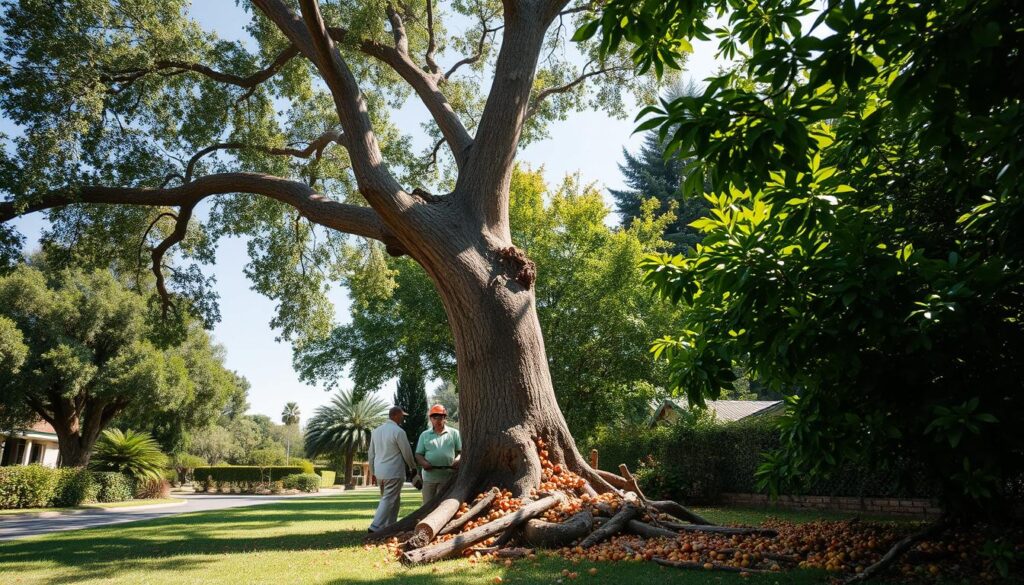
Tree Felling Centurion is our specialist team for safe, controlled work on residential plots and estates. We remove old, diseased or hazardous specimens and offer related services like stump clearing, selective pruning and emergency call-outs.
We are fully qualified and insured, and we plan each job to suit tight suburban stands and estate rules around the N1/N14 interchange and the R21 corridor in the City of Tshwane. Expect considerate scheduling, neighbour-friendly timings and tidy sites when we finish.
Request an on-site assessment and quote so we can outline safety measures and a clear timeline. We bring experience, confidence and a friendly approach to every job – Get My Free Quote
Professional fruit tree removal Centurion for safer gardens and healthier landscapes
When a mature specimen shows clear hazards, we give practical, safety-led advice so you can choose the right course of action. Our approach balances preservation with protection and avoids unnecessary intervention.

What professional work looks like
Professional tree crews set up planned work zones, use controlled cutting techniques and protect lawns, walls and garden structures. We apply risk assessments before starting and follow strict site safety procedures.
When to choose removal over care
Removal is the best option for advanced disease, structural instability, repeated limb failure, severe lean or major root damage. Where the specimen is sound, we often recommend pruning or treatment as a less invasive alternative.
- Checklist of risk signs: deadwood, brittle or peeling bark, cracks at unions.
- Heavy limbs over sheds, pools or paths; progressive trunk lean.
- Repeated limb failure or major root upheaval.
Older specimens can become top-heavy and fail during summer storms or high winds. After removal, gardens gain light for lawns and beds, room for new planting and fewer pest harbours.
We keep the service consultative. Correct diagnosis prevents needless work while still keeping people, pets and property safe. Our expert advice and tree services include tree trimming and ongoing care where that is the sensible option.
Why Centurion homeowners choose us for fruit tree removal
A. Local homeowners trust us because we combine practical planning with quick, courteous service on every job. We are known for clear communication and reliable scheduling across the suburb’s stands, complexes and security estates.

Fully insured, qualified teams and safety-first planning
Tree Felling Centurion is fully insured and qualified. We plan each task around safety, access and protection of buildings, paving and garden features.
Before work starts we identify fall zones, decide on sectional dismantling and map routes for narrow side passages. This planning reduces risk for roofs, garages and boundary walls.
Neat clean-ups that leave your property tidy
We clear branches, logs and rubble and finish with a rake and blow-down so the area looks complete. Our crews leave sites tidy and neighbour-friendly.
Customers consistently praise our professional crew, neat results and efficient turnaround.
Fast turnaround and dependable scheduling
We offer fast quotations and agree realistic time windows. We arrive prepared, keep clients updated and adapt if weather affects safe work.
Our experience across stand-alone homes, complexes and estates means we control noise and respect neighbour courtesies.
| Feature | What we do | Benefit to you |
|---|---|---|
| Insurance & qualifications | Fully certified crews and public liability cover | Reduced risk and peace of mind for your property |
| Pre-job planning | Fall zones, sectional cuts, access mapping | Safer work near roofs, walls and paved areas |
| Site clearance | Branch removal, log haul, final tidy | Clean finish, ready for replanting or landscaping |
Old and diseased fruit trees: the most common reasons for removal
Old specimens can shift from useful garden features to genuine hazards if their structure breaks down. We explain why removal is often the safest, most practical choice for homeowners.

Declining productivity and structural weakness
As trees age they may give less yield while becoming brittle. That creates a low reward, high risk situation for a busy household.
Typical issues include hollowing trunks, weak limb unions and repeated dieback. Limbs can fail under fruit load or in strong winds.
Stopping disease spread to nearby plantings
Diseased specimens can infect ornamentals and other productive trees. Sometimes removal is the best way to protect the rest of your garden.
“Removing a compromised specimen is not a failure of upkeep; it is a responsible safety step.”
| Reason | Common sign | Homeowner action |
|---|---|---|
| Structural failure | Cracks, hollow trunk, repeated limb drop | Plan removal or sectional work to ensure safety |
| Disease risk | Persistent dieback, fungal fruiting bodies | Remove and dispose responsibly; avoid storing material on-site |
| Low productivity | Sparse canopy, poor harvest | Consider pruning, care or full removal if risk remains |
We advise on timing to reduce disruption and recommend responsible disposal so infected wood does not linger. Unstable specimens near play areas, parking or living spaces should not be left to chance. For complex situations we offer a professional tree assessment and, where needed, safe tree removal.
Fruit tree hazards we manage around homes, walls and driveways
Hazards close to homes and driveways often start small but can quickly become a safety and maintenance burden. We focus on clear, local solutions so your garden and access stay usable and safe.

Overhanging branches near roofs, garages and garden structures
We protect tiled roofs, garage doors, carports and pergolas from storm breakage and constant gutter blockages. Overhanging limbs can rub and tear fascias and roofing sheets during wind. For cables and narrow side passages we use sectional, controlled cutting and specialist tools to avoid damage.
Roots affecting paving, boundary walls and underground services
Mature trees often send roots under driveways and paving. That lifts slabs, cracks boundary walls and can foul underground services. Where access is tight, we select the right equipment and adopt precision cutting to limit further disturbance.
Falling fruit, slippery walkways and pest attraction
Fallen fruit bruises and ferments. That attracts insects and rodents and makes walkways slippery. Trimming can reduce mess and risk, but if the structure fails or roots cause ongoing damage, removal is often the cleaner long-term fix.
Our safe removal process from assessment to final clearance
We follow a clear, step-by-step process so you always know what will happen from our arrival to the final tidy-up.
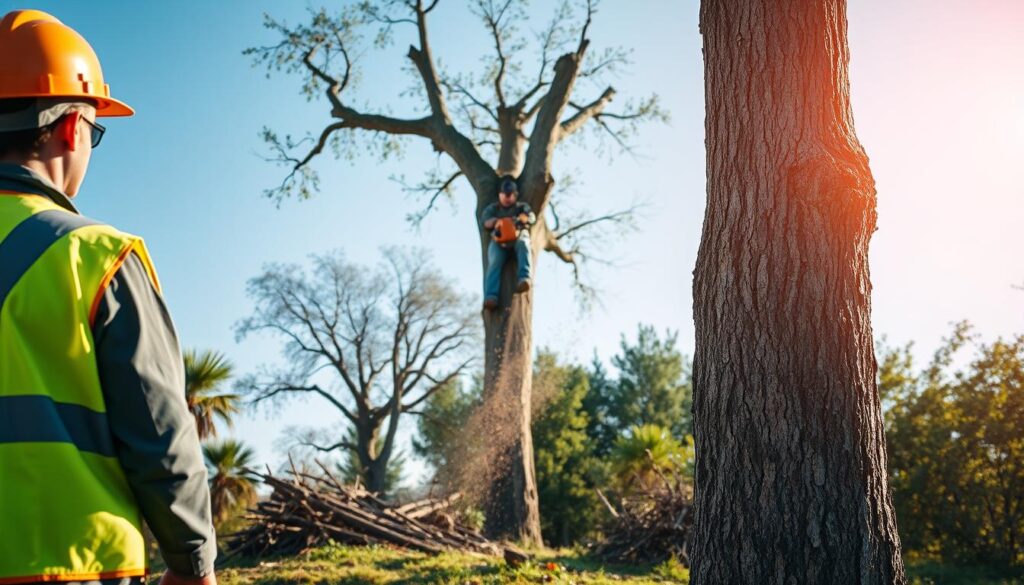
On-site evaluation and risk assessment
We begin with an on-site survey to assess condition, lean, targets and safe working zones. We map access routes and note any obstacles before we start any cutting.
Sectional cutting for tight spaces
Where access is limited, we use sectional dismantling. Our crews remove limbs piece-by-piece to protect roofs, walls and neighbours’ gardens.
Controlled felling where space allows
When space permits, we carry out planned tree felling. We choose a fall direction, prepare a landing zone and apply proven felling techniques to reduce risk.
Rubble removal and responsible disposal
After the job we stack, load and remove debris so your garden is left tidy and usable. We separate green waste and wood for recycling where practical and avoid leaving hazardous material on-site.
Clear communication throughout
We keep you informed about the sequence, timing and any safety restrictions. This ensures the process is safe, efficient and finishes with a clean site.
Tree cutting equipment and techniques for precise, controlled work
Good technique and the right kit turn a risky job into a tidy, predictable result for any yard. We focus on clear methods that protect buildings, pools and paved areas while keeping disruption to a minimum.

Specialised tools for height, access and difficult angles
Equipment matters because controlled work cuts the chance of property damage and speeds up difficult access tasks.
- Professional-grade saws for clean cuts and faster work.
- Rigging and rope systems to lower large limbs safely.
- Access gear for height work, keeping crews steady and secure.
Directional felling and sectional dismantling
Directional felling is a planned method. We choose a fall line and make guiding cuts so the trunk lands where it is safe.
Sectional dismantling removes the canopy in pieces when there is no clear single-drop space. This protects walls, fences and neighbouring gardens.
“Technique is what separates a controlled job from a high‑risk gamble.”
We always pick the least invasive option—from light tree pruning and tree trimming to full felling—so the result matches the safety need and your garden plans.
Emergency tree removal after storms, splits or sudden collapses
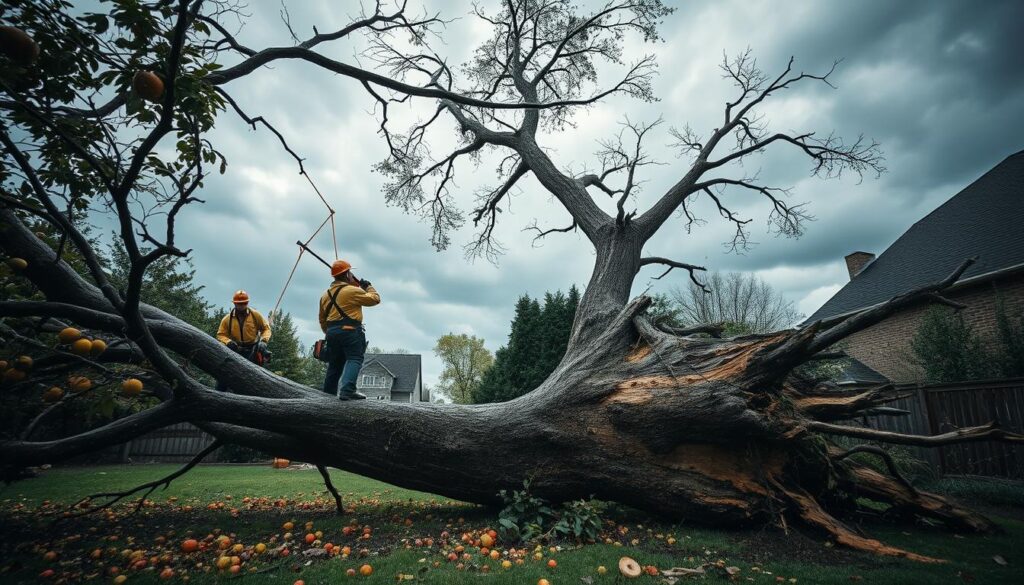
When sudden storm damage puts people or vehicles at risk, we respond quickly to secure the scene. Our focus is calm, clear triage and fast action to protect your home and neighbours.
24/7 readiness for urgent hazards on your property
We offer 24/7 service and prioritise hazardous situations where life, cars or buildings face immediate danger. In true emergencies we act first to make the area safe, then plan the full work.
Making the area safe first: unstable limbs and hanging branches
Make-safe work is our first step. That may mean stabilising a split trunk, removing hanging limbs or cordoning off a danger zone to prevent secondary failures.
We use controlled rope work and sectional felling to lower risky pieces without causing further damage.
Priority call-outs when access roads or driveways are blocked
Blocked driveways and access routes get urgent attention so residents can leave or emergency services can access the site. We clear timber first, then follow with tidy-up and full removal when conditions are safe.
South African summer storms can be sudden and severe. Our rapid, safety-first approach keeps families, neighbours and property protected while we work to resolve the hazard.
Stump removal and stump grinding to finish the job properly
A leftover stump can be a long-term nuisance, spoiling a neat garden and complicating new landscaping.
We offer clear options so you know what each approach enables for replanting, lawn or paving. Stump removal can include full extraction or grinding to below ground level.
Full removal versus grinding: what suits your garden
Full removal clears the root plate and allows deep replanting or level paving. It is more invasive but leaves a solid, workable surface.
Grinding is faster and less disruptive. It leaves mulch and wood chips we can clear or use as soil dressing.
| Option | What it leaves | Best for |
|---|---|---|
| Full removal | Hole filled and levelled | New foundations, paving or large replanting |
| Stump grinding | Mulch/wood chips; roots remain | Lawns, beds, quick tidy finish |
| Combined approach | Targeted root work and clean surface | Restricted access or complex roots |
Dealing with deep roots and preparing the area
Mature specimens often have deep, wide roots that can disturb soil and hardscaping. We assess access and use the right equipment and tools to limit upheaval.
We tidy the grindings or remove them if you prefer, then level and compact the area so it’s ready for lawn, paving or a new planting.
“A planned finish saves time and cost when you remake the space.”
Scope affects prices. Smaller grind jobs start from around R2,500; deeper extraction or tight access raises costs. We plan the method that gives the best result with the least disruption and ongoing care for your garden and nearby tree roots.
Tree trimming and pruning as an alternative to full removal
Not every mature specimen needs to be felled; careful trimming can resolve many issues while keeping shade and seasonal yield. We assess condition and offer pruning that reduces hazards without unnecessary loss.
Reducing interference with neighbouring properties and fences
Pruning can stop overhang disputes and protect fences from rubbing limbs. We remove crossing branches and tidy boundary canopies to keep light and privacy balanced.
Corrective pruning also reduces branch drop into adjacent yards and prevents ongoing fence damage from rubbing and pressure.
Keeping growth away from cables and high-risk zones
We maintain safe clearances from overhead lines and sensitive structures. Targeted trimming lowers the sail effect in wind and removes deadwood that can fall on cables.
Work near heights or cables is risky. For safety, hire professionals rather than attempt DIY pruning on tall specimens.
| Action | What it achieves | Best for |
|---|---|---|
| Light trimming | Reduces overhang, keeps fruit and shade | Minor nuisance issues |
| Corrective pruning | Removes weak limbs, improves structure | Wind risk and crossing branches |
| Clearance pruning | Creates safe distance from cables and walls | High-risk zones near lines or roofs |
We recommend pruning and tree pruning when it manages risk and cost. If advanced decay or instability exists, removal remains the safest option and we will advise that honestly.
Local knowledge for Centurion properties, estates and complexes
Working in centurion means we plan around gated entrances, peak traffic and estate rules to avoid surprises on the day.
Working around access rules in complexes and security estates
We book security check‑ins and arrange permits before arrival. This speeds up setup and keeps your shared areas clear.
We also align with HOAs on permitted hours and protect communal infrastructure like paving, irrigation and fences.
Minimising disruption in busy residential streets
We plan arrival windows around the N1/N14 interchange and the R21 corridor to avoid peak delays.
On narrow lanes we set tight work zones, control pedestrian routes and use banksmen to keep school runs safe.
Small actions—prompt debris clearance, considerate noise timing and clear signage—reduce neighbour complaints.
| Consideration | What we do | Benefit |
|---|---|---|
| Access & security | Pre‑book check‑ins; coordinate loading bays | Faster setup; fewer delays to the job |
| Estate rules | Work to HOA hours; protect shared services | Compliance and lower risk of fines |
| Traffic & pedestrian safety | Schedule around peak routes; manage crossings | Safer site and minimal disruption to neighbours |
These local plans form part of our professional service. They draw on on‑the‑ground experience so each job runs smoothly and your property stays protected.
Service coverage across Centurion neighbourhoods
We cover the suburb’s main areas with planned work and urgent call‑outs. Our local teams respond quickly across a wide footprint, tailoring methods to each site’s access and garden size.
Highveld, Rooihuiskraal, Clubview and Die Hoewes
Highveld and Rooihuiskraal often have tighter stands; we use sectional dismantling and careful rigging for narrow access. In Clubview and Die Hoewes, larger gardens let us work with directional felling where safe.
Irene, Eldoraigne, Hennopspark and Doringkloof
Irene and Eldoraigne feature established plots and mature landscaping. We plan for sensitive sites near pools and irrigation. Hennopspark and Doringkloof bring mixed demands, from pruning to urgent clearances after storms.
Amberfield, The Reeds, Wierda Park and Zwartkop
Amberfield and The Reeds see more estate-style properties; we co‑ordinate with HOAs. Wierda Park and Zwartkop include both homes and small commercial sites, so we provide flexible tree felling services for varied needs.
Service note: We provide full coverage for residential and commercial properties, offering scheduled maintenance and emergency call‑outs. For local planning we suggest a simple table mapping each area to typical requests—Area vs Typical requests (e.g., hazards, stump grinding, pruning near walls)—so clients can see which services suit their suburb.
| Area | Typical requests | Access type |
|---|---|---|
| Highveld / Rooihuiskraal | Pruning, stump grinding, tight-access dismantle | Tight stands, narrow passages |
| Irene / Eldoraigne | Storm clearance, preservation pruning, root work | Established gardens, larger plots |
| Wierda Park / Zwartkop | Tree felling services, site clearance, commercial jobs | Mixed residential and small commercial sites |
Landmarks we commonly work near in Centurion
Local landmarks help us plan routes, kit needs and arrival windows so jobs run smoothly. We use what we know about each pocket to pick the safest approach and mobilise quickly.
Irene Village and the N1/N14 corridor
Irene Village and the linking routes to the N1 and N14 form a busy corridor. Many requests here involve careful work near boundary walls and mature gardens.
Rietvlei Nature Reserve surrounds
Properties around Rietvlei face higher wind exposure. That increases the risk of storm damage and leaning specimens, so we plan for secure rigging and fast response.
Jan Smuts House Museum area and older suburbs
The Jan Smuts House Museum area includes established gardens with older planting. We carry out sensitive, controlled felling and finish with neat clearance to protect heritage lawns and beds.
- Why landmarks matter: better route planning, accurate timing and correct equipment choice.
- We adapt: from tight drives to dense beds, our tree services match each micro‑area’s limits.
- Quicker mobilisation: local familiarity means faster, safer outcomes for removal centurion enquiries.
In short, we use landmark knowledge to reduce delays and tailor our services so every job fits the site and neighbours’ needs.
Tree removal services for residential and commercial sites
We offer tailored clearance options for homes and businesses, so each site gets the right balance of safety, speed and neatness.
Home gardens, rental properties and new renovations
In private gardens we protect lawns, play areas and pets while keeping neighbours informed. Our scope covers careful pruning, stump work and tidy site clearance so the space is safe and ready for replanting or landscaping.
For rentals and renovations we plan around new walls, driveways and kerb appeal. That means minimising dust, avoiding damage to new finishes and scheduling work to suit handover dates.
Office parks, retail sites and shared-access properties
On commercial sites we focus on pedestrian safety, parking access and business continuity. Our teams provide risk assessments, traffic control and timed shifts to reduce disruption to staff and customers.
We handle palms and other specialist specimens as part of our wider services. With professional tree planning and compliance checks, we reduce liability for facilities managers and make the job predictable.
Tree felling prices in Centurion: what affects the cost
Knowing typical ranges and what alters them makes budgeting for felling far simpler. We explain the main cost drivers so quotes are transparent and realistic.
Tree size categories and typical price ranges
Size and condition are the principal factors that set prices. Below are indicative ranges; site conditions can move any quote up or down.
| Size | Indicative price | Typical time |
|---|---|---|
| Small | R500 – R850 | ~2 hours |
| Medium | R860 – R2,500 | 2–4 hours |
| Large | R2,600 – R7,500 | 3–5 hours |
| Huge | R7,600 – R15,000 | 4–6+ hours |
Note: these tree felling prices are indicative; complex sites or safety needs can change the range.
Access difficulty: close to buildings, tight yards and obstacles
Tight access, overhangs near roofs or obstacles like pools and sheds increase labour and kit needs. Sectional dismantling, tight‑rope rigging or specialist lifts raise the scope and the cost.
Add-ons that change scope: stump grinding, pruning and site clearance
Common extras include stump removal or grinding, pruning or trimming of adjacent specimens, and broader green‑waste clearance. Each add‑on adds time and equipment to the job.
Many jobs take roughly 2–6 hours depending on size and whether a stump is included. Our quotes reflect safety planning, insured crews and proper equipment, plus a tidy handover.
For an accurate price, we recommend an on‑site assessment so we can evaluate size, access and exact scope before quoting.
What to expect on the day of your fruit tree removal
On the scheduled day we run a clear plan so you know who arrives, what we do and when we finish.
Typical flow and timeframes
We arrive at the agreed time, carry out a short safety briefing and set up exclusion zones. Then we begin controlled cutting and sectional dismantling where needed.
Most jobs take between 2–6 hours depending on size and whether stump work is included. Complex access or deep root extraction can extend that schedule.
Noise, safety and keeping people clear
Sawing and mechanical cutting are noisy but time‑bound. We aim to complete efficiently and limit loud work to agreed windows.
Safety zones are established around the working area. Please keep children, pets and bystanders well away until we confirm the site is safe.
Property access and final tidy
Please ensure driveways and gates are available so loaders and equipment can park and move debris off-site.
We manage debris removal and leave the area tidy and usable. We also aim to minimise neighbour disruption and work considerately throughout the job.
| Stage | What we do | Why it matters |
|---|---|---|
| Arrival & briefing | Confirm scope, hazards and exclusion zones | Sets clear expectations and improves safety |
| Cutting & dismantle | Controlled cutting, sectional lowering | Protects property and reduces risk |
| Debris management | Stack, load and remove timber and grindings | Site left clean and ready for reuse |
| Final check | Walkthrough with the client | Ensures satisfaction and confirms finish |
Ready to Reclaim Your Garden? Get a Free Quote Today
When safety, speed and neatness matter most, our crews deliver a controlled outcome and a tidy handover.
We promise safe, professional tree felling that protects people, property and the look of your garden. We finish with a clear site and a full walkthrough so you know the next steps.
Decisions: remove when the specimen is old, diseased or structurally unsound; prune when shape and health can be preserved with pruning or tree trimming.
We offer 24/7 emergency response for urgent hazards and emergency tree make‑safe work. Our full scope covers tree felling services, stump removal, palm work, felling services and selective trimming.
Familiar with local estates and routes around Irene Village, the N1/N14 corridor and Rietvlei, we tailor plans to each site. Request an on‑site assessment and a detailed quote so we can confirm the safest approach and timeframe. Tree Felling Centurion is the trusted choice; we’ll do the rest.

